Historical Archives
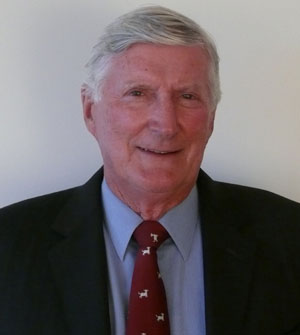
Tribute to Don ‘DJ’ Cameron
February 20, 1933-September 7, 2016
By Campbell Burnes
Not too far from the bar at the Barbarians clubrooms you will find Sleepy’s Corner, where lie many of Don Cameron’s sports books, which he kindly donated to the club a few years ago.
It was the sort of selfless gesture one had come to expect from this generous man, who died yesterday with a legacy intact as one of the country’s great sports writers.
A prolific wordsmith whose style was of a different age, when journalistic essays, imbued with perspective, were the norm rather than the tight, fast-paced reports of today. That is not to say DJ, or Sleepy to his mates (perhaps on account of his prodigious eyebrows), was not prolific and industrious. Far from it. He wrote several books, filled with his descriptive, some might say florid, prose.
You see, he learned from the master, TP McLean, and succeeded the great scribe as the Herald’s senior rugby writer in the late 1970s. In all, he was at the paper for nigh on 50 years. His status was already secure as the country’s finest cricket journalist, so he worked hard 12 months of the year. But he made many of his rugby friends covering the Auckland teams of the 1950s and ‘60s, carving a reputation as a player’s journo, always able to honour an off the record chat. Playing euchre down the back of the team bus was a good way to gain trust. Unimaginable now.
He was a legend of the press box, but not an aloof character. Rather he was a welcoming presence to wide-eyed young journos of all abilities and pretensions. This writer can recall sitting between DJ and Lindsay Knight, another Barbarian, at a North Harbour NPC match in 2002. I cannot recall much of the game, but I can tell you I learned more in 80 minutes listening to the musings of those two gentlemen. Indeed, DJ was most helpful to my career, quick with an encouraging word. He was straight on the phone when I went through the most challenging period in 2007. You discover your true friends and colleagues in those times.
DJ loved the Barbarians and their ethos, and enjoyed swapping tales with a cold one at the Eden Park premises. There was little ego to the man and he was not one to force his views in a debate.
The Barbarians motto: ‘Rugby is a game for gentlemen in all classes but for no bad sportsman in any class’ could have been made with DJ Cameron in mind.
DJ died in Auckland, aged 83, after a short illness. Funeral details will follow shortly, but they will come from far and wide to farewell this gentleman.
Interview with Maurice ('Morrie') McHugh on 12/02/2003
Pupil at Sacred Heart College, Auckland from 1931-34
All Black No. 458
Barbarian RFC member
Born in Auckland, February 19, 1917
Died in Auckland, September 25, 2010 aged 93
(This interview was given for the Sacred Heart College centenary
in 2003, when many prominent old boys were invited to give
their recollections. It had several additions until McHugh's
death in 2010. It was passed onto Kevin Barry by McHugh's
daughter Frances, and Barry in turn passed it on to Bryan
Williams in early 2014).
Both my parents were born in South Canterbury, and my four
grandparents were born in Ireland. I know one of my grandparents
came from Swanlinbar in County Leitram and another from Knowley
just across the border in Fermanagh, Northern Ireland. All
my grandparents arrived in New Zealand in the 1880s and settled
in South Canterbury.
My father's family had a farm in Darfield, Canterbury. My
mother's name was Slattery. Her family had a small farm in
Hawkden, Canterbury.
My father Andrew was a blacksmith in Canterbury before joining
the police force. He was posted to Auckland in 1911 and became
a detective. In the 1940s he was transferred to other districts,
including Hamilton during World War Two but retired to Auckland.
When he first came to Auckland in 1911 he played for the College
Rifles club. I remember he once said he thought the Marist
club had liquor on the premises so did not play for them at
first.
But a few years later he did join Marist. He represented
Auckland as a loose forward in 1915 and in 1921 when he played
against the visiting South Africans in the first international
match played at Eden Park. This was for a combined Auckland-North
Auckland side. My father marked the South African loose forward
Morkel and a photo of my father tackling him was in the Auckland
Rugby Union's headquarters for many years.
He married in 1916.
In 1919-20 he was involved in the well-known Eyre murder
trial. Captain Eyre, a former Canadian army officer who farmed
in Onewhero, left his wife and children on the farm when he
served overseas in World War One. A farm manager by the name
of Thorne ran the farm. Eyre returned in 1919 and paid off
his manager. In 1920, he (Eyre) was murdered one night when
he was shot through his bedroom window. My father was involved
in the case and, having been a blacksmith, was able to identify
a horse belonging to the former farm manager by examining
his hoof prints near the Eyre house. I remember the name of
the horse: Mickey. This was crucial evidence in bringing about
the conviction of Mr Thorne. This case was brought to the
notice of the public during the Arthur Allan Thomas case in
the 1970s as there were similarities, and the Thorne convicted
in the case was a distant relative of Arthur Allan Thomas.
In fact, one lawyer defending Thomas suggested that one of
Captain Eyre's grandsons could have been the killer of Harvey
and Jeanette Crew.
I was the eldest of seven children (four boys and three girls).
My second brother was Joe - he left Sacred Heart in 1934 and
joined the police force. He died some years ago after he had
served in the force for many years. Andrew, the third brother,
attended SHC from 1936-39 and was in the champion 1939 First
XV, later playing senior rugby for Marist. He became an accountant
and died in 1993. He was an accountant for the Whangarei Harbour
Board during a high profile case when the chairman was charged
with misappropriation. My youngest brother Pat went to St
Peter's College in Epsom and still lives in what was the family
home in Kenyon Avenue, Mt Eden. He was also involved in the
motor car business and regularly made cars available to the
clergy on good terms. At present he part-owns a restaurant
in Devonport.
We were living in Rendell Place, Kingsland, when I was born
in 1917, but in 1928 my father bought the house in Kenyon
Avenue. I started school at St Benedict's. I recall my first
day there in 1923. The sister, a St Joseph's nun, told me
what to draw and copy, telling Pat Schollum, who had been
there a few months longer, to help me. He immediately told
me to do things slightly differently from what the sister
had said, much to the annoyance of the good sister. Pat was
the father of the SHC principal Brendan Schollum (who died
in 2014). We were to be in the same class right throughout
our schooling and Pat was always a real extrovert, a personality
who always wanted to liven up things. Later at SHC he led
the performance of the haka when the First XV were playing.
John Mackey (the bishop), John Molloy (an Auckland rugby rep)
and another John Molloy (well known Eden-Epsom and Auckland
tennis player) were also at St Benedict's with me. The Pascoe
girls (from another well-known Auckland family) also attended,
though I don't think they were Catholics. There was also a
Ken Maynyard who later became a champion long-distance runner.
On leaving St Benedict's, I went to the Marist brothers'
school in Vermont Street from 1928-30 (standards 4-6). Brother
Calixtus was the principal and also taught me in my first
year. Until I started at Vermont Street I had not played rugby
apart from kicking a ball around and skylarking with my friends.
Brother Calixtus was one of the finest teachers I ever had
and a master rugby coach. His name is still remembered in
primary school rugby through the Brother Calixtus Shield.
From 1917-25 Vermont St. won the Auckland primary school
A grade championship seven times under his coaching. I remember
once I had been sick and failed to complete my homework. He
excused me, stating that I had played so well the previous
week that no wonder I had become exhausted! I recall he stated
once that he started teaching when he was 19, then some months
later said he had been teaching for 30 years, and asked if
anyone knew how old he was. To his surprise, I gave the correct
answer immediately. He was only in his early 50s when he died
in 1932. He had taken ill after a St Pat's night concert.
I remember the last time I saw him when he was resting on
the upstairs balcony of SHC watching us on the near field.
St Patrick's Cathedral was packed for his funeral, with most
of the Auckland Rugby Union executive being present.
When I started at SHC in 1931, the Depression was on its
way and there were a lot of poor people around. With seven
children to provide for, we struggled, but Dad had a secure
job in the police force, so we never wanted for the essentials.
But many Catholic children went on to Seddon Tech as their
parents were poor and did not want to ask for financial help
to attend a Catholic secondary school. The roll at SHC shows
a steep decline during the Depression years, especially among
the boarders. Many of the better-off Catholics were in the
hotel trade and their children were able to attend SHC (the
Dunns, Molloys, Coopers, Schollums, Sheehans, Trestons, et
cetera).
I loved my years at SHC - the brothers were dedicated teachers
and took a real interest in us. I recall that I was often
late. I had to catch a tram to Karangahape Road, then walk
to the top of Pitt Street to catch the Richmond Road tram,
and invariably I missed it. The train boys from south Auckland
arrived in Auckland at 8.40am, so they came on a tram which
reached college at 9.10am. Sometimes I would get on the tram
with them and make my way in unnoticed because we usually
had drill (PE) first thing in the morning. However, I remember
Brother Hippolyte coming into the room once and warning me
about being late. He was a difficult man to fool. Brother
Remigius, a very gentle, devout man, was acting principal
for the year in 1933, and we then had Brother Tarcisius, whom
I would describe as a devout, jovial, wonderfully composed
and capable man. He never seemed to raise his voice. He taught
me English in Form Six. I recall once he was reading us a
poem by William Wordsworth in which the term 'loafer' was
mentioned. He asked if anyone knew what a loafer was. My father,
of course, had been a blacksmith and a horseman. I immediately
put my hand up and was the only boy in the class that knew
a loafer was a half-bred greyhound used for chasing hares
at a hunt...
Brother Tarcisius, a South Islander, liked horses and said
he once did riding work as a jockey when he was a boy. His
nephew was the late Hon. Frank Gill, a former cabinet minister
and later New Zealand ambassador to Washington.
I admired Brother Gerald, a nephew of the world champion
boxer Billy Murphy, the only NZ-born boxer to ever win a world
professional title. Br Gerald was very devout and some boys
referred to him as 'Creeping Jesus'. The Murphys were originally
an Auckland family, but he came from the West Coast because
his father had married a local girl and settled there. He
once said that when he was a pupil at the brothers' school
in Greymouth and was only 14, a brother asked them if anyone
would like to join the brotherhood. He said he would and in
a few short weeks was on his way by boat to Australia. He
was in his 90s when he died. An obituary was written by a
good friend of mine, none other than the late Sir Terry McLean,
the doyen of New Zealand sports writers. McLean and I were
overseas together in North Africa.
Another well-known brother was Brother Mark, who taught French
and Latin. He was somewhat feared among the boys and was the
sort of brother I would describe as being 'quick on the trigger.'
He was quite young at the time but probably over-strict.
I suppose rugby was my favourite sport, as I was in the First
XV for three years and gained secondary school representation.
We had a very good First XV in 1934 when we were runners-up,
losing only two games - one to King's College, whom we beat
in the second round, and one to Auckland Grammar School, with
whom we drew in the second round. Six of this team were later
to play provincial rugby: halfback Frank Cooney (Auckland),
wing Jack Barry (Auckland), wing Jack Molloy (Auckland), Tom
Kawe (Otago and NZ Maori), fullback Bill Hare (North Island
and Auckland) and myself. Eric Wordsworth, the college athletics
champion and an Auckland schools title-holder, was an outstanding
centre. Given the ball quickly from set play, he could get
through a gap in a flash. He was small of stature. Unfortunately
he was out injured for several games and I am sure we could
have been champions if we had him for every game. Other members
of this First XV were Barry O'Regan, later a knight and a
High Court judge, and Pat Dunn, later Doctor Dunn, father
of Bishop Pat Dunn. Most of us served overseas in World War
Two. Brother Aloysius was our rugby coach. Only two of us
are still alive (in 2003): Dave Gamble, a former naval lieutenant,
and myself. I was also the college shot put champion and was
second in the secondary schools competition, along with being
the college heavyweight boxing champion for a couple of years,
and a school prefect.
I recall John Mackey (later to be bishop) taking part in
the college boxing championships. He was beaten by a tough
country boy - a Ryan - but he showed courage and determination.
I remember one of the brothers later congratulating him, saying
'like St Paul, you fought the good fight.' He was a real pleasant
young lad whose father died in Ireland in 1919 when he was
very young and his mother came out to New Zealand with him
and kept house for her brother, who was the parish priest
of Epsom, Father O'Brynne (died 1934). It did not surprise
me that he later became our bishop. During the August holidays
in 1934, I managed to play a few games for the Auckland Marist
senior team.
I was pleased to leave SHC with my matric and am forever
grateful for what I learnt at the college. The Catholic faith
has always been strong in our family life and I have never
had any hang-ups, fear or guilt complexes about the Catholic
faith. I am often disappointed as regards the attitude of
many young people towards the faith today. Perhaps a bit more
moral and religious fervour would do them no harm.
On leaving SHC, I worked in the customs department in 1935
and started to study law. Pat Schollum likewise started law
with me. However, after two years, I gave law studies away.
I was too involved in sport: rugby, athletics and boxing.
My father, who was an extremely mild and quiet man, never
criticised my decision, but I felt that he would have liked
his children to pursue a profession. He did not have a secondary
education, but he did his best to give his children the opportunity
he never had.
In 1938 I was the New Zealand amateur heavyweight boxing
champion. The finals were held in Gisborne.
Late in 1938 I sailed to England on the Rimutaka for my overseas
experience. In London, I played rugby for the Catford Bridge
Club. Rugby in London was not really competitive and was a
middle class game played by professional men. As one Englishman
famously said, 'We play rugby to keep fit, whereas you New
Zealanders keep fit to play rugby.'
I travelled on the continent in the northern summer of 1939
and got as far as Northern Italy, where there were a lot of
Italian troops training. With the threat of war likely in
Europe and many tourists leaving, I cut short my trip and
set sail back to New Zealand, arriving in Auckland a few days
before the war broke out on September 3, 1939.
I joined up with the NZ Army medical corps and went into
Burnham Camp in November 1939. I went overseas with the First
Echelon in 1940 and we were stationed in Egypt. (While in
Egypt, Morrie was the army boxing champion, beating George
Nelson, an army captain and a lifetime friend, in the final).
We went out on several patrols in North Africa but it was
in April 1941 that we really went into action in Greece and
Crete. In Greece I was with the 16th Battalion as a medic.
George Nelson, a captain in the 18th Battalion, asked me to
join his battalion, so I transferred to the 18th. By May we
retreated to Crete. There I remember at 8am on May 20, 1941,
we had just had breakfast on what was a clear, fine day, the
sky suddenly filled with German aircraft, not like the previous
mornings when there were brief bombing raids. The sky was
crowded with what looked like 100 aircraft, and within a few
minutes thousands of German paratroopers, while German fighters
strafed the fields around the airfield we were supposed to
defend. Then gliders were dispatched from a second wave of
aircraft. The Germans suffered heavy casualties as the gliders
slowly landed and the German troops leaving them were immediately
machine-gunned by our men. There were so many Germans landing
that, without an air force, we did not have a show from the
beginning, and it was only a week before we started evacuation
procedures, especially after the Germans captured Maleme Airfield.
Many Germans were able to land at one end of the island without
any opposition whatsoever. Our company was soon surrounded
and we had no chance whatsoever of continuing the battle with
any hope of survival. Thus I was a POW in Crete from May-June
1941 and also spent a few weeks in a 'military hospital.'
We were in a prison camp near the coast and there was a sandy
trench and scrub between the camp and the shore. Part of the
prison camp was a former hospital. The German guards would
allow us to go swimming most days. After six weeks, learning
that we were to be shipped to Germany, another prisoner, by
the name of Yeo, and myself decided that we would make a dash
for freedom. The guards would patrol the fence and report
every few minutes at the sentry boxes during the night. We
carefully determined how long it took them to patrol each
area then stealthily slipped under the wire at about 4am one
morning. We hid in the sandy trench outside the prison fence
until we heard them report to one another. It was soon evident
that they had not seen us so we carefully wormed our way through
the scrub and made off. It would be six weeks before we got
off Crete. The locals fed us, but we could only approach them
at night because if they were caught helping us they could
be shot, whereas we would only be taken back to the camp.
I remember one night we called at a Cretan farm house and
a woman in there started screaming hysterically, no doubt
realising who we were and what could happen to them. However,
the Cretan farmer gave us food and took us down the back of
the farm to a hut where we were able to spend a few nights.
We eventually reached the cliffs on the south side of the
island. There were quite a few of us in hiding and the Germans
were closing in on us so we were constantly 'on the run.'
We received a message that a British submarine, 'The Torbay',
would be coming to pick us up one night. On the appointed
night we swam out to this waiting submarine holding on to
a rope which was attached to the submarine. There was a group
of us and those of us who could swim had to assist any non-swimmer.
The captain of the submarine was Captain Myers, a very devout
Catholic, as I soon discovered. Later in the war he was awarded
the Victoria Cross. We were brought back to Egypt, later lined
up before the NZ Division and praised by General Freyberg
for our courage. He then said that as a reward he would give
us two weeks' special leave, "knowing" that we would
be anxious to have another go at the Germans. Sadly, one comrade
who had escaped with us later lost his life in action in North
Africa. During the later months of 1941 and early '42, we
spent some time in Lebanon and made several forays into Libya
before taking part in the great battle of El Alamein from
October 1942. This was a turning point in the North African
campaign.
In the weeks before El Alamein, Freyberg organised several
sporting events. The main contest was the rugby series between
New Zealand, England and South Africa. I was determined to
make the NZ Division team and after several trials was selected.
The final against South Africa was like a test match. We won
and were congratulated personally by Freyberg. I do not recall
any of what became the Kiwis in 19456 being in this New Zealand
team, but most of them joined us later in the war. Sadly,
several of the 1942 NZ players lost their lives later.
In 1943 many of us from the First Echelon were brought back
to New Zealand on leave. I had a broken bone in my lower arm
as a result of one of our army rugby matches and it took some
time to mend. As a result, I was discharged from the forces.
I returned to my customs job but did not stay there very long.
So in 1944 I was back in Auckland playing rugby for Marist
and Auckland. My parents were then living in Hamilton where
my father was in charge of the Hamilton police station. It
was in Hamilton that I met my wife Sylvia McLaughlin, whom
I married in 1946. She died in 1991. We had four daughters,
one of whom died in 2001.
In 1944 I settled in Auckland and lived at the Victoria Hotel
in Victoria Street, run by the Trigg family (ex-SHC). I met
up with Ivan Stonex, who ran a huge dairy farm in Papatoetoe
and was head of the Stonex Brothers milk factory in Auckland.
Ivan was a keen rugby supporter and offered me a job as a
driver of a milk truck. This was an essential service and
I felt I needed an outdoor job after the stress of the North
African campaign. Don Wright, and Auckland league rep and
an allround sportsman, also worked for the Stonex family.
He ran my milk-carrying contract when I was away playing rugby.
I was in the Marist senior teams from 1934-38 and from 1944-50.
We won the Gallaher Shield in 1939 when I was absent overseas,
and in 1947 and 1950.
Morrie played in both tests against the Australian touring
team in 1946 as a side-row forward, openside in the first
test and blindside in the second. He was not selected among
the 26 to go on tour to Australia in 1947. Morrie was still
a top player, but the selectors preferred younger talent.
In 1946 Morrie fought in the final for the New Zealand amateur
heavyweight boxing championship against Jack Boyd of Taranaki
in the Auckland Town Hall. This was in the same week that
Morrie played in a test match against Australia. He lost the
final. In 1947 he was beaten in a preliminary by Kevin Skinner,
whom Morrie had beaten in 1946. Skinner went on to win the
title in 1947. There were no All Blacks matches in 1948.
Morrie was one of 30 players selected in September 1948 to
tour South Africa in 1949. In April of that year, at the age
of 32, Morrie went on the long tour of South Africa where
he played in 13 of the matches, including one test, the third,
where he played in the No 8 position. Much was expected of
this side, but all four tests were lost, though two of these
were lost on penalty kicks. Okey Geffin was an outstanding
goalkicker and he was the obvious difference for the Springboks.
The All Blacks coach Alex McDonald was 65, but Morrie said
he had been a good coach and deserved the tour. He had served
New Zealand rugby well and this tour was a just reward for
his services to the game. He once said that good coaches are
good coaches because they have good teams. He agreed to share
coaching responsibilities on the tour. Much ill-informed criticism
has been written about this tour. Morrie said there were neither
disputes nor revolts among team members. Most of the players
were from Otago and Auckland, but there was no ill-feeling,
nor were there any cliques or differences between the ex-Kiwis
and the younger members. He said that the Springboks were
better organised and made the most of their opportunities
in the tests, which were all close. There were some weaknesses
in the team as New Zealand's best halfbacks were not on the
tour - Percy Tetzlaff had just retired, while Vince Bevan
and Doctor MN Paewai were both Maori and could not tour South
Africa. In the third test, Neville Black, a first five, played
halfback. For each of the four tests, New Zealand had a different
No 8. Morrie said the day of the third test, in which he played
No 8, was an extremely hot 80 degrees Fahrenheit (36 Celsius)
in the shade. The All Blacks lost 9-3, scoring the only try
with South Africa kicking three penalties. Two of these were
scrum penalties and hooker Has Catley seemed to get the blame,
but both were doubtful penalties. The second penalty in the
seventh minute was the most controversial. South Africa had
kicked across field to the All Blacks' 25. Bob Scott took
the ball and kicked for touch, but was immediately penalised
for shepherding behind the winger Bill Meates. Morrie said
he had run back and was in a good position to see the incident.
He did not think Scott had used Meates as a shepherd, but
from the position of the referee Morrie said he could see
how the referee misjudged the incident. Referees do not always
see it from the players' point of view, nor are they always
in the best position. The All Blacks always considered they
were robbed in this test, as they played the better rugby
and Morrie himself had a good game. The referee - Hofmeyer
- came in for much criticism after this test.
There were nine Catholics in this All Blacks side (10 in
the group with Winston McCarthy). They all attended mass regularly
on Sundays and suffered no discrimination or criticism from
other players. Morrie had the task of finding out the time
of Sunday mass at each location and informing the others.
Harry Frazer, who was a member of the team, became engaged
to a South African girl during the tour. Morrie said her remembered
one morning the engagement was reported to the paper in South
Africa and this was the first many in the All Blacks' side
knew of it. They woke up Frazer to tell him that it was in
the morning paper with many details about him. The first thing
Frazer said was 'Have they got my weight correct?'
Morrie retired from rep rugby after this tour. He spent another
two years working for Stonex Brothers delivering milk to schools
and dairies in Auckland's eastern suburbs. His wife was a
Hamilton girl and his parents settled in Hamilton in 1953
where he worked as a carrier for his friend Flynn for a while,
then as a salesman for the Dunlop Tyre company, which enabled
him to travel about the Waikato and meet up with many sportsmen,
then for Brian Faire, who was a land agent and eventually
Morrie worked for an insurance company. In Hamilton he became
player/coach for the City club. Some Marist supporters were
unhappy with this move but Morrie said he wanted to coach
at the senior level and Hamilton Marist were well set up.
From 1958-62 he worked as a clerk for the Meremere Power
Station. Returning to Auckland in 1963 he continued to work
for the same insurance company he was involved with in Hamilton,
and he also had a season coaching the Auckland Marist seniors,
without much success.
Living near the motorway in Papatoetoe, Morrie for many years
was a great help at Otara's St John's Parish. He would frequently
help at school with a reading recovery programme for young
Polynesians. For several years right up until 1999 he drove
each week into St Matthew's in the City to collect food parcels
for the deserving poor in the Otara district. He was also
an active member of the third Order of St Francis. In 2004
he was a Eucharistic minister at Holy Cross parish in Papatoetoe.
His surviving three daughters and their families lived in
Papatoetoe and Manurewa, while his deceased daughters' family
live in Kawakawa, Northland.
In September 2004 at the SHC sports centenary dinner, Maurice
McHugh was named as a member of the SHC First XV of the Century.
For a period of some seven weeks until his death in 2010,
he was the oldest surviving All Black.
Tribute to Mike Cormack
*This fine tribute to a dearly departed Barbarian was penned
by Philip Wells and appeared in the May newsletter of the
Martelli McKegg law firm, Mike's old workplace.
Michael Campbell McIntosh Cormack
July 23, 1938 - May 11, 2012
Mike will be remembered for his many attributes, his sharp
legal mind, easy gracious personality, competitive nature,
sporting prowess, generosity, and his humour.
Mention the name Mike Cormack to most people of my generation
and it immediately brings to mind Mike's last minute conversion
of Waka Nathan's try at Eden Park in 1960.
That conversion clinched the 18-17 win by Auckland over Canterbury
and meant the retention of the Ranfurly Shield. In all, Mike
played 45 games for Auckland as a fearless, dependable fullback.
He was also an All Blacks trialist, a member of the 1966
Gallaher Shield-winning University side and in the 1970s coached
the Varsity premiers. Mike served as president of the Varsity
club in 1987-88 coached the NZ Universities national team
and was a life member of the Varsity and Barbarians clubs.
Yes, Mike was an integral part of those glory days of Auckland
rugby under Fred Allen's careful eye but there was much more
to the man than rugby.
Mike's sporting heritage was undeniable - his mother Jean
played golf for Auckland, was a University of NZ tennis titleholder
and was named captain of the NZ netball team. His father was
also a good sportsman and a very handy golfer. Mike grew up
as a very good allrounder - sports included cricket, rugby,
tennis, golf, fly fishing and duck shooting.
With his King's College education, abundant charm and a law
degree under his belt, Mike spent a couple of years making
international friends living and working in the UK where his
rugby skills were again evident and Mike had his first introduction
as a player for the Barbarians club. His close association
with that club was to continue right through his life, including
his election to president in 2006-07 and culminating with
the naming of the main corporate box in the relocated Baabaas
clubrooms at Eden Park as the Mike Cormack Suite.
This honour, which took place just three days before his
death, recognised the contribution Mike's perseverance, great
negotiating skills and sharp legal mind had made to the successful
relocation of the club into the ASB Stand. In typical Cormack
fashion, Mike shrugged off all help in spite of his failing
health to reply with a brilliant, incisive and humorous speech.
It was a fitting tribute to Mike, who was surrounded by family
and friends.
While sport was an integral part of Mike's life, it was only
one facet. Following his time in the UK, Mike returned to
NZ to become a partner of Turner Hopkins before joining this
firm in 1977 as a senior partner under its then name of Martelli
McKegg Wells and Cormack. Mike remained here until his death
and continued to be a skilled and valued mentor to clients,
fellow partners and staff. Mike was a favourite amongst all.
Our staff were enamoured with his wit, his easy conversational
skills, his dancing ability and his occasional renditions
in song and dance of those saucy ditties he had soaked up
in his rugby days.
Mike never turned his back on those institutions that had
helped him. I well remember the many appeals with which he
helped or spearheaded unstintingly over the years. They included
raising funds for the University Rugby Club's premises at
Merton Road, for the completion of the Holy Trinity Cathedral,
for the Barbarians Rugby Club and for the King's College Foundation.
In spite of his many other pressures, Mike always had time
for family and friends. Annual trips away with his share club
were interspersed with holidays which usually involved sporting
activity of some sort, often golf. At his home in Remuera
and at his beach house at Langs Beach, Mike enjoyed hosting
children, grandchildren, clients and friends. From Langs he
frequently made the journey north to assist his long-time
friend and client Julian Robertson in the setting up of Kauri
Cliffs Golf Course, now a world-class course and resort.
Mike's wife Ruth has the hardest road ahead. She has lost
not only her soulmate but her golfing partner.
Tribute to Peter Fatialofa
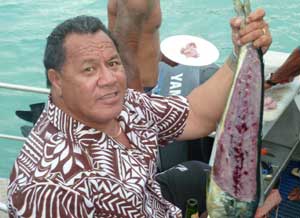 Papali'itele
Peter Momoe Fatialofa Papali'itele
Peter Momoe Fatialofa
April 26, 1959 - November 6, 2013
By Campbell Burnes
'Fats' was many things to many people, and not just in rugby.
But he was certainly one of the most down-to-earth sports
stars you are likely to meet. In this respect, you could compare
Fats to league legend Ruben Wiki. They would treat you the
same, whether they were talking to the Queen or to some wide-eyed
young kid.
Some of the stories surrounding Fats always raise a smile.
He was a genuinely funny guy with a positive outlook on life,
a life he lived in the fast lane. How his scrum-damaged knees
were up to playing squash so often is beyond me.
I first met him when my University team played Ponsonby during
the 1995 premier club season, but I didn't get to know him
until the Manu Samoa tour of the UK later that year.
Our first game together was a hit-out in Apia in the most
cloying humidity I have experienced, not to mention 35 degree
heat. I made the mistake of wearing thick, woollen winter
socks. As a result, so much sweat dripped down into my boots
that my two relatively easily penalty shots at goal were badly
astray.
Quick as you please, Fats called out: "Campbell, I thought
you could kick!"
I may have taken offence, but with Fats you just had to laugh.
He was the only man I knew who could look the same after
12 hours on the rumbos as he did at the start. Never try and
go one-for-one with him for more than an hour.
Fats was also responsible for my passage onto the 2000 Manu
Samoa tour to the UK. After we had played a game for the Barbarians
against the Auckland Grammar School First XV, I must have
made a decent impression on him because he called me at work
on the Monday.
The exchange went something like this:
"Campbell, Fats here. Do you want to come on the Manu
Samoa tour?"
"Sure would, Fats. When's the trial?"
"There's no trial. You're in!"
Easiest team I ever made.
More than anyone, Peter Fats was front and centre of the
resurgence of Manu Samoa in the global game, and became a
great ambassador for his country and its rugby.
My favourite Fats quote, out of the hundreds that made good
copy?
It came in a post-match TV interview when Manu Samoa had been
humbled 73-3 by Australia in 1994: "Geez, we might have
to row home now!"
We will miss one of rugby's true characters.
50th Jubilee 1937-1987
Pages are in PDF format.
50th Jubilee 1937-1987
Presidents foreword
The founders
How it started - Hugh McLean
The Barbarians - Terry McLean
Great games great moments
Barbarians club and school matches
- Bob Graham
A firm base for the Baa-baas
- Terry McLean
Barbarian tours overseas - Murray
Reid
The 1987 Barbarian ETA Foods
Jubilee tour of UK and Ireland - Kevin Barry
Barbarian RFC - first class
team record 1938-86
Barbarian RFC register of players
(first class) 1938-86
Barbarian RFC life members
Barbarian RFC presidents
List of members as at 17 February
1987
Barbarians past who have heard
the final whistle
|